|
I am the majority owner and president of Atlantic Computing. This is the second incarnation of |
| security discipline and began operating as Atlantic again around 2012. Since then, Atlantic has been focused |

|
President—Brainhat, 1996 - present

|
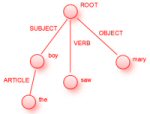
Brainhat is an effort to slay the quintessential challenge in computer science: to create a sentient machine. Given a long time horizon, we've been able to make some great strides. Brainhat's technology is knowledge-based computing, where |
| It has the potential to be a foundation for household robotics, predictive security, simulation and automation. Past Brainhat work included sustained efforts with speech recognition, VoiceXML, robotics (for NASA), and human language interfaces to simulation, entertainment and telephony. The program has |
|
President—U.S. Operations, Integralis, 2000 - 2001
| Following the sale of Atlantic to Articon-Integralis in 2000, I ran the U.S. operations. I continued to |

|
President—Atlantic Computing, 1993 - 2000

|
I founded the company that was to become the U.S. presence for Integralis, a multinational network security integrator. |
From nothing, we built a great staff, customer base, managed security practice, infrastructure, and a channel program that Integralis still enjoys to this day.
Atlantic began by helping other organizations connect to the Internet and build the infrastructures needed for web services and communications. We soon adopted a wide variety of security offerings. We produced custom URL filters, hand-crafted exploits and protections, and managed service components.
For a time, Atlantic was the largest Check Point and Nokia reseller on the East Coast. We had a customer base that spanned the U.S. I personally cultivated relationships with Bell Atlantic (Verizon), Sprint and MCI so that we could resell network security products through their sales forces. Atlantic was acquired by Integralis in combination with a secondary offering on the Neuer Markt (now defunct) in spring, 2000.
Staff Lead—Advanced Computing Technology Center, 1990 - 1993
| I was the senior staff member in a corporate-funded project to bring advanced computing technologies to UTC divisions. Particularly, we |

|
Development Engineer—Multiflow Computer,
1985 - 1990

|
Multiflow Computer was a minisupercomputer start-up out of Yale. We produced a Very Long Instruction Word machine from scratch and sold almost 100 units. In my role, I proselytized, helped customers port and benchmark applications and trained other |
Nuclear Engineer—Combustion Engineering,
1981 - 1985
| I worked primarily on simulators and safety systems that came about as a response to the |

|
|
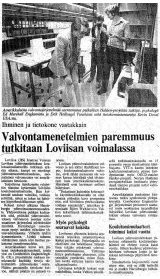
transient so they could better understand
what was happening. I spent most of the summer of 1982 at the Loviisa Nuclear Power Station in southern Finland involved in an OECD test of the usefulness of these systems. This newspaper clip is from the Helsingen Sanomat. That is me in the simulator control room, near the bookcase. I performed a year-long safety systems simulator upgrade to Southern California Edison's San Onofre plant. I designed and built a number of panel instrumentation for Baltimore Gas and Electric's Calvert Cliffs plant simulator. |
|
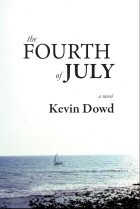
The Fourth of July My first published work of fiction (2012) was the product of start-up publisher, Roundabout Press. The manuscript was chosen through a competitive review process. Funding for the initial printing was raised through a Kickstarter campaign.
|
Niantic Bay Yacht Club, 1959-present
| I have served in many roles including Vice Commodore, Rear Commodore, Treasurer, Assistant Treasurer, Corresponding Secretary and the kid with the biggest stereo, running the teen dances through the late 1970s. I was Commodore in 2018 and 2019. NBYC is a great club a great club with a competitive sailing legacy. |

|
Member—Atlantic Class Association
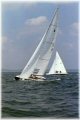
| I have an Atlantic Class 30' one-design sloop, Flying Cloud, hull number four. A4 is my second Atlantic. We race out of Niantic Bay and compete with fleets from Madison, Cedar Point, Cold Spring Harbor, NY and Blue Hill, ME. The Atlantic is beautful boat, designed by Starling Burgess in the 1920s. I am a third generation Atlantic owner within my family. My grandfather bought his first in 1941. www.atlanticclass.org |
|
Amateur Musician
|
I protest that fixing my own pipes doesn't make me a professional plumber. So I think it is with "musicians." But, I have been playing music for fifty years, and I know a few tricks, so I guess I must be at an amateur plumber level, at least. I like to play a bit of classical piano. But one of my favorite musical distractions is winging it. I gave up the band that always |
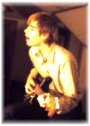 |
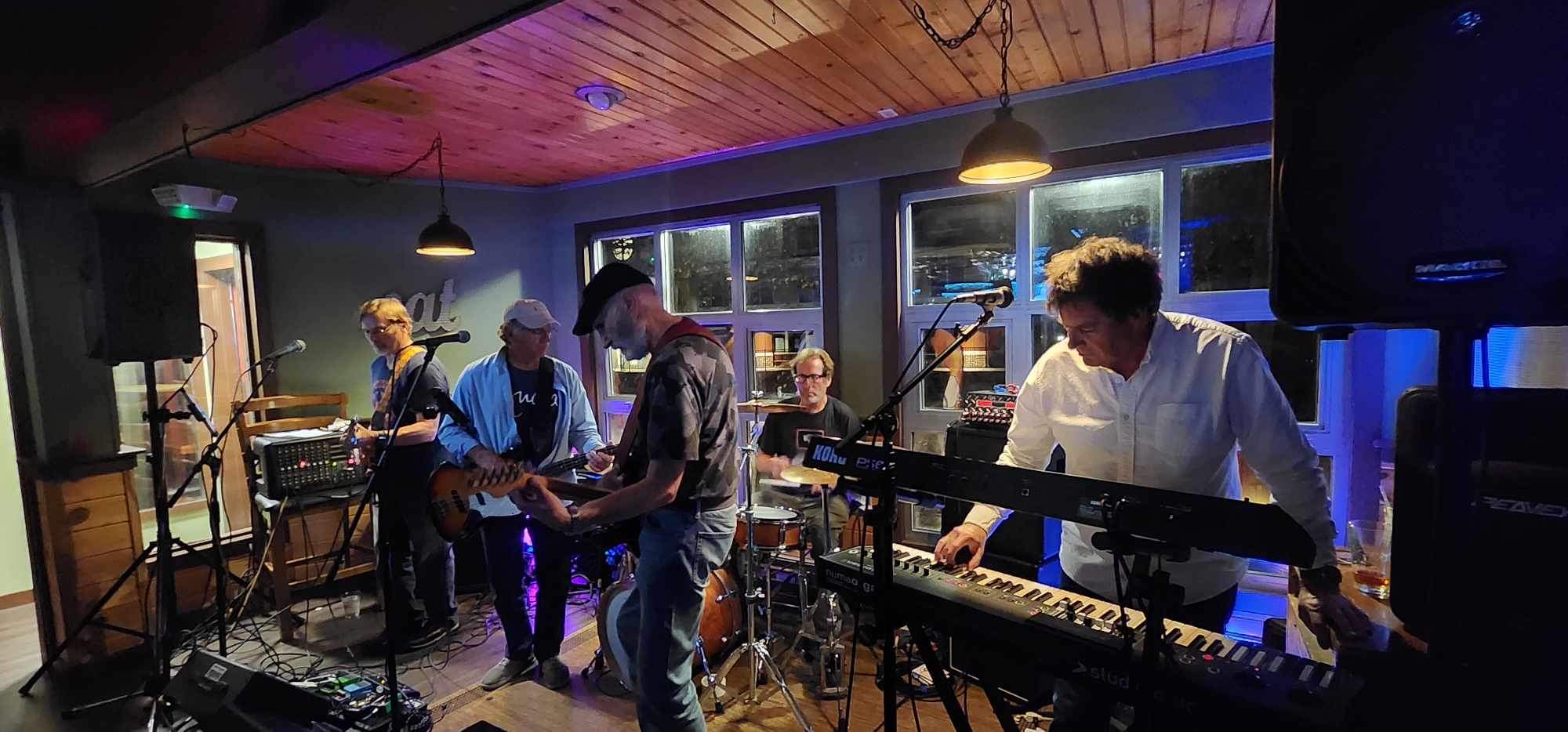
The last fifteen years or so, I have played out with The Bosco Brothers a few times a year. Still making pocket money! The last three years have been the remnants of Fountain Head years. Here we are playing Thanksgiving at Tavern on the Tracks in 2023:
|
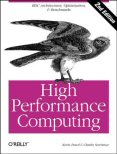
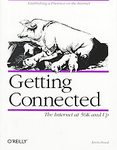
Technical Books I've published a couple of technical books. Of the two technical books, my far-and-away favorite is High Performance Computing. It came out at a time when "high performance computing" meant parallel supercomputers, like Cray machines and weird massively parallel matrix architectures.
I completed the book when I was working at United Technologies Research Center (UTRC) in 1993. UTRC was a goldmine for information about the computer architectures from the 50s and 60s. A lot of the engineers just reaching retirement age had worked with the IBM 704 and other neat old computers. They still had the manuals! High Performance Computing started to age by the late nineties, and the publisher took it out of print. Charles Severance of the University of Michigan wrote me and said "I'll update it!," which he did quite ably, and it went back into print for a time. Interestingly, High Performance Computing still shows up in the reference lists on syllabi. And it sells for more than it did when it was in print! That makes me happy—a 30 year-old computer book that's still relevant.
|